
Case study
Working Safely at Heights.
How do we get veteran technicians to follow safety protocol when crew culture punishes compliance?
Industry: Industrial air conditioning maintenance · Year: 2025
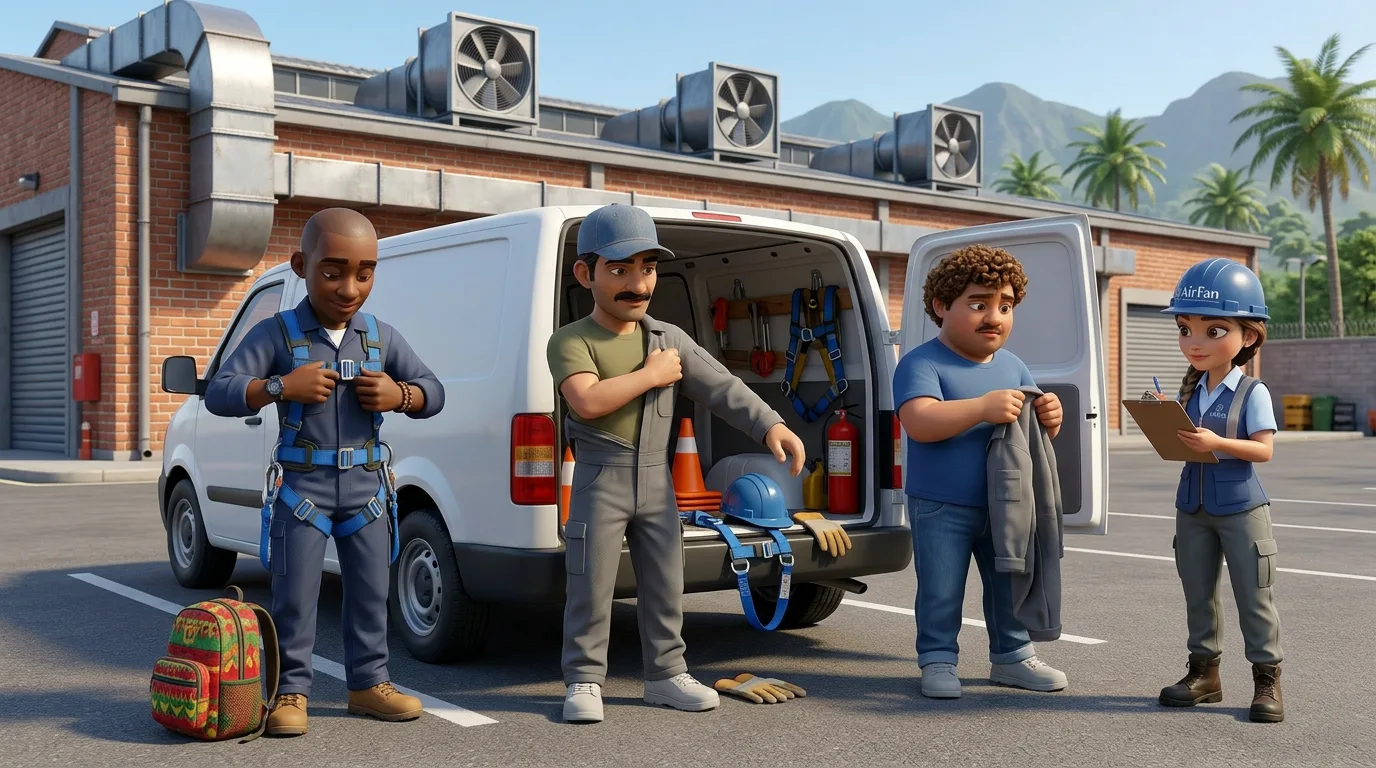
The problem
In Colombia, working at heights is regulated by Resolución 1409 de 2012, one of the country's most rigorous occupational safety standards. Anyone working more than 1.5 meters above ground must be certified and follow a specific protocol. Non-compliance isn't just a violation. It can be the difference between life and death.
The data is stark: in 2023, 694 workers died in Colombia from work-related causes. Falls from heights rank among the leading causes of occupational death in industrial maintenance and construction, a sector that saw a 47.4% increase compared to 2022.
Our client, a leader in industrial HVAC maintenance, knew these numbers. Their technicians were certified. Protocols existed. The company invested in training. And yet, in the field, safe practices remained inconsistent, especially among the most experienced workers.
The client didn't have an information problem. They had a culture problem.
The diagnosis
What we found in the field
Before writing a single line of script, we went to the field. We watched technicians work. We interviewed them, not in the office, but on the rooftops where they operate. What we found explained everything.
Veteran technicians, the ones with 10, 15, 20 years without a fall, had developed a deep certainty: "I know what I'm doing. I know myself. I know these heights." This is what psychologists call survivorship bias: a track record of success becomes evidence that precautions are for others, for the inexperienced, for those who don't know better.
But there was something more. Within crew dynamics, following the protocol to the letter had a visible social cost: you were "the slow one," "the one who does the whole process," the one who slows the group down. The fast worker, the one who "knows how to do it without the full harness", was admired, not sanctioned. Crew culture punished compliance.
What COM-B tells us
COM-B Framework: Capability · Opportunity · Motivation → Behavior
Capability ✓
Technicians know how to follow the protocol. There was no knowledge gap. Training had worked at that level.
Opportunity ✗
The social environment (social opportunity) penalized compliance. The crew norm was speed, not safety.
Motivation ✗
Automatic motivation reinforced the shortcut. The protocol required conscious effort; the habit did not.
The intervention couldn't be a video that taught the steps. It had to be a video that changed how the group sees the person who follows them.
The intervention
Andrés
The central character is Andrés: a veteran technician in his fifties. We're in fable territory, not documentary realism, and that matters. The fable form lets us address a taboo subject, the death of a colleague, without the weight of a documentary or the distance of a report.
The story: Andrés is on a rooftop when a routine maneuver goes wrong. In the instant before the accident, a younger version of himself appears, him at 25, just starting out. Then another. And another. Across the rooftops of Medellín, Andrés meets 22 previous versions of himself. Each one represents a year when he took that same shortcut and survived. Survivorship bias, personified.
The climax: a row of 23 candles lighting one by one, each representing a version that made it this far. Then, one by one, they go out. Until one remains, trembling. The film never shows an impact, a fall, a victim. It doesn't need to. The emotion is in what isn't shown.
The film's final line: "The most experienced worker isn't the one who needs fewer steps. It's the one who already does them without thinking." This line is the film's central operation: it redefines what it means to be a veteran. Following the protocol is no longer a sign of inexperience, it's the mark of mastery. The social norm shift the COM-B diagnostic identified as necessary.
The results
Measurement in progress. The film was produced in 2025; post-implementation behavioral validation is ongoing with the client.
We'll update this section when we have field data. Publishing metrics without validation would be exactly the kind of communication Cauce™ doesn't do.
Credits
- Creative Direction & Production
- Miguel Zuluaga
- Strategy & Behavioral Diagnosis
- Emerito team
- Tools & methods
- COM-B framework · Field observation · Google Nano Banana (storyboard)
Do you have a behavioral problem that traditional communication hasn't solved?
Let's talk.
Schedule a conversation →